
What is cord blood banking?
Cord blood banking is the process of collecting umbilical cord blood at birth and storing it for future use. It’s a once-in-a-lifetime opportunity to save the most powerful source of stem cells your baby will ever have.
Your unborn baby may be part of the first generation to live beyond 100. As we age, the likelihood of needing medical intervention increases; regenerative medicine using stem cells could play a vital role in keeping them healthy.
Did you know that you can secure the most powerful readily available sources of stem cells within minutes of birth by choosing cord blood banking?
Your baby’s umbilical cord is possibly the richest source of stem cells they may ever have. With cord blood banking, you can collect these powerful cells from the umbilical cord and placenta and store them for potential use in established and future stem cell therapies.
Current stem cell therapies can treat a range of 80+ diseases, including immune and blood disorders. In most of these treatments, doctors will tend to use stem cells from a donor, such as a sibling.
The main reason why millions of parents choose to bank their baby’s stem cells is the incredible potential they hold for regenerative medicine therapies in the future. In years to come, should clinical trials succeed, your baby could use their own, perfectly matched stem cells to repair damaged tissue, regenerate old organs or even replace body parts.
Today, cord blood banking is already changing lives and there have already been more than 1 million stem cell transplants around the world since the 1980s.[1]
Doctors and scientists believe that cord blood stem cells could be one of the cornerstones of regenerative medicine. These stem cells are currently being investigated in thousands of clinical trials for many incurable conditions, such as cerebral palsy, autism and diabetes.[2][3]
More than a decade ago, it was predicted that 1 in 3 of us will require a regenerative therapy.[4] Today, those chances could be even higher. As part of the first generation that could live beyond 100 – choosing cord blood banking ensures your baby will have their own stem cells ready for use if they ever need them.
You only get one chance to bank your baby’s cord blood – in the moments after birth. To receive more information about the cord blood banking process and cord blood storage benefits, download your Parents’ Guide now.
Read our stem cell storage FAQs for answers to the most common questions about cord blood banking and stem cell storage.
Your unborn baby may be part of the first generation to live beyond 100. As we age, the likelihood of needing medical intervention increases; regenerative medicine using stem cells could play a vital role in keeping them healthy.
Did you know that you can secure the most powerful readily available sources of stem cells within minutes of birth by choosing cord blood banking?
Your baby’s umbilical cord is possibly the richest source of stem cells they may ever have. With cord blood banking, you can collect these powerful cells from the umbilical cord and placenta and store them for potential use in established and future stem cell therapies.
The main reason why millions of parents choose to bank their baby’s stem cells is the incredible potential they hold for regenerative medicine therapies in the future. In years to come, should clinical trials succeed, your baby could use their own, perfectly matched stem cells to repair damaged tissue, regenerate old organs or even replace body parts.
Today, cord blood banking is already changing lives and there have already been more than 1 million stem cell transplants around the world since the 1980s.[1]
Doctors and scientists believe that cord blood stem cells could be one of the cornerstones of regenerative medicine. These stem cells are currently being investigated in thousands of clinical trials for many incurable conditions, such as cerebral palsy, autism and diabetes.[2][3]
More than a decade ago, it was predicted that 1 in 3 of us will require a regenerative therapy.[4] Today, those chances could be even higher. As part of the first generation that could live beyond 100 – choosing cord blood banking ensures your baby will have their own stem cells ready for use if they ever need them.
You only get one chance to bank your baby’s cord blood – in the moments after birth. To receive more information about the cord blood banking process and cord blood storage benefits, download your Parents’ Guide now.
Read our stem cell storage FAQs for answers to the most common questions about cord blood banking and stem cell storage.
Watch the class on cord blood banking
Ten minutes with our chief executive Claudia Rees on what your baby’s cord blood could be used for, and why there’s only one chance to collect it. Long enough to know whether it’s for you. It is one of 18 classes in Antenatal by Cells4Life, our online antenatal course – yours free with your welcome pack.


1 MILLION STEM
CELL TRANSPLANTS

7,500+
CLINICAL TRIALS

5 MILLION
UNITS STORED

22 CELLS4LIFE
SAMPLE RELEASES

What are the benefits of cord blood banking?
Here’s why you should save cord blood today:

Umbilical cord blood banking is completely risk-free, and non-invasive, yet could support your baby’s health for the rest of their life. In fact, the procedure takes place in another room after the third stage of labour, so it does not have an impact on your birthing plan.

Your baby’s cord blood is their perfect biological match. This means for treatments that can be autologous, there is no risk of the immune system rejecting it. Your baby’s cord blood could also be a match for siblings, and a good enough match for parents.

Cord blood banking preserves powerful stem cells. They are routinely used to treat more than 80 conditions, mostly with matched donor stem cells, and are the subject of more than 7,600 clinical trials for various regenerative therapies.
LEARN MORE ABOUT TREATMENTS USING CORD BLOOD STEM CELLS
Why choose Cells4Life?
Cells4Life is the leader in cord blood banking in the UK, with more UK samples in storage than any other bank. Everything about our service has been designed for one purpose – to provide your baby and your family with the best preparation possible for their long-term health.
Here are just a few cord blood banking benefits when you choose to store with with Cells4Life:
- Up to 2.2x more stem cells when you upgrade from Cells to CellsPlus*
- Multiple samples with SecurePlus
- Dual location storage with SecurePlus
- Most comprehensive range of services
- The UK’s only placenta storage bank
- The UK’s only cord blood bank with its own online antenatal course – free with your welcome pack
- Year-round collection
- Dedicated couriers
- Industry leading technology
- HTA licensed

Cord blood banking: what happens on the day?
Cord blood banking is non-invasive and should have no impact upon your birth plan or delivery process. The collection will take place in a separate room, after the third stage of labour. Either your consultant or a trained and licensed phlebotomist, provided by Cells4Life, can perform the collection. Once they collect the cord blood, one of our dedicated medical couriers will come to the maternity unit to collect the sample and bring it directly back to our laboratory. We will then process the cord blood, perform various tests and place it securely into long term storage. Should your child or a family member ever need to use the sample, all you have to do is contact us and we will liaise with your medical facility to release the stem cells for treatment.
STEM CELL COLLECTION – WHAT’S INVOLVED?
Why bank cord blood?

Baby’s perfect match
Storing your baby’s own cord blood ensures that they will always have access to their perfect stem cell match. This means for treatments that can use a person’s own cells, there is no need for anti-rejection drugs. Your baby’s stem cells may also be a perfect match for a sibling and are always a partial match for the parents.
Whilst suitable stem cells may be available from donor registries, the chances of finding a tissue match can be as low as 30%. Having your child or their sibling’s perfect or good enough match ready and waiting increases the chances they will have access to compatible cells, without risk of rejection.

Bank it, don’t bin it
Cord blood is far too important to waste, yet, if it is not collected and banked, it is routinely thrown away. By storing your baby’s precious umbilical cord blood, you can ensure this valuable resource is always available to help protect them for the rest of their life.
This is why over 4 million families worldwide have chosen to protect their baby’s health by banking their cord blood.[6]
How is cord blood used? The future of medicine
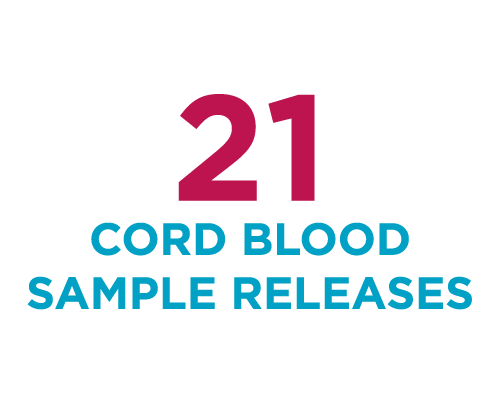
Possible uses of cord blood are increasing faster than ever before as the promise of regenerative medicine starts to be realised. Currently, there are more than 1,000 clinical trials investigating umbilical cord blood – and new discoveries happen all the time.[7] We have already released 21 cord blood samples for use in established therapies and clinical trials for conditions such as autism, cerebral palsy and Diamond-Blackfan anaemia.
Why should I bank my baby’s own cord blood?
Cord blood banking preserves powerful stem cells and ensures your baby can enjoy the benefits of cord blood storage:

Choice
Banking your child’s own cord blood and tissue means that they, and the rest of your family, have exclusive use of the stem cells – how you need them, when you need them.

Protection
Your baby’s cord blood is their perfect biological match, which means treatments that can use a person’s own cells carry no risk of rejection. It is also possible siblings and parents can use the sample too.

Security
The chances of finding a stem cell match in a public cord blood bank can be as low as 30% and for some ethnic groups, the chances are even lower. Private cord blood banking ensures your child’s perfect match is ready and waiting whenever they need it.

Quick questions…
FIND OUT MORE, REQUEST YOUR WELCOME PACK TODAY
Everything you need to decide about cord blood banking – and, while you decide, Antenatal by Cells4Life: 18 online classes with Cass McNamara, BBC Scotland’s Ask the Midwife, on birth, feeding, newborn care and recovery. It’s free when you request your welcome pack.
Provide your contact details to request:
- Complete Welcome Pack and Parent’s Guide
- Your discount
- save £300
on cord blood banking
- Information via email
- Free access to our full 18-class online antenatal course, including a video class on cord blood banking
- A call from one of our specialist advisers
*based on our peer reviewed publication showing that TotiCyte delivers up to 2.2 times more haematopoietic stem cells at the point of use than our next best system, AXP.
References
1. Gratwohl A et al. “One million haemopoietic stem-cell transplants: a retrospective observational study.” Lancet Haematology 2015 Mar;2(3):e91-100 <https://www.ncbi.nlm.nih.gov/pubmed/26687803>
2. “Umbilical Cord Blood Improves Motor Skills in Some Children With Cerebral Palsy” Duke Health News & Media, accessed 18 March 2019, https://corporate.dukehealth.org/news-listing/umbilical-cord-blood-improves-motor-skills-some-children-cerebral-palsy
3. Dawson et al. “Autologous Cord Blood Infusions Are Safe and Feasible in Young Children with Autism Spectrum Disorder: Results of a Single‐Center Phase I Open‐Label Trial” Stem Cells Translational Medicine 6;5:1332-1339
4. Harris, David T. “Cord Blood Stem Cells: A Review of Potential Neurological Applications” Stem Cell Review 2008 4:269–274 <https://stemcelltreatmentnow.com/files/studies/Cord-Blood-Stem-Cells-A-Review-of-Potential-Neurological-Applications.pdf>
5. Levitt, Alice. “A Ghost (Heart) of a Chance” Houstonia Magazine, accessed 18 March 2019. <https://www.houstoniamag.com/articles/2017/1/23/texas-heart-institute-new-research-ghost-heart>
6. Ballen KK et al. “Umbilical cord blood donation: public or private?” Bone Marrow Transplant 2015 Oct;50(10):1271-8
7. Clinical Trials Gov, accessed 18 March 2019, https://clinicaltrials.gov/ct2/results?cond=&term=cord+blood&cntry=&state=&city=&dist=