
Key details
- World first: Surgeons at Hamilton Health Sciences in Canada have carried out a novel, world-first burn treatment using exosomes – tiny particles released by stem cells – on an 18-year-old patient with severe facial and neck burns. [1]
- The therapy: Exosomes were derived from mesenchymal stem cells taken from umbilical cord and amniotic tissue, and were injected into the burns to speed healing and calm inflammation. [1]
- The result: The patient avoided skin grafts to her face and neck, with results her surgeon described as “absolutely remarkable”. [1]
- Early days: This is a single, compassionate-use case, now written up as a case report; larger controlled trials are still needed before the treatment could become standard of care. [1]
What happened?
In December 2025, an 18-year-old Western University student, Kaitlin Jeffrey, suffered deep burns to her face, neck, hands, and arm in a flash fire. She was transferred to Hamilton General Hospital, home to one of Ontario’s two regional burn centres, where her care was led by Dr Marc Jeschke, an internationally recognised burn surgeon. [1]
Determined to spare her face and neck from skin grafts, Dr Jeschke proposed something that had never been tried in a burns patient: injecting exosomes, sometimes called stem cell particles, into the burns. With approval from Health Canada on compassionate grounds, his team became the first in the world to use the approach on a burn patient. After cleaning the wounds, they gave two treatments a few days apart, using around one trillion exosomes in total. As a safeguard, the team also applied platelet-rich plasma (PRP) – a concentrate prepared from the patient’s own blood – to the wounds, in case the exosomes did not work as well as hoped. [1]
The results to Kaitlin’s face were, in Dr Jeschke’s words, “absolutely remarkable”; he has said you cannot tell she was ever burned. She also healed faster, and with better results, than another patient whose burns were serious but less severe. [1] Kaitlin avoided skin grafts to her face and neck altogether, although she did need grafts for the burns to her hands and arm, and her neck is still healing with the help of PRP and laser treatment. [1]
How are severe burns treated now?
For deep burns, the standard of care is a skin graft, in which a thin layer of the patient’s own healthy skin is taken from one part of the body and placed over the wound. [2] Grafting protects the wound, lowers the risk of infection, and helps new skin grow. [2] But it can leave scarring and a patch-like appearance, and the graft creates a second wound at the donor site. [1][2] Particularly for a young person, the psychological impact of scarring to the face and neck can be considerable. [1]
What are stem cell particles?
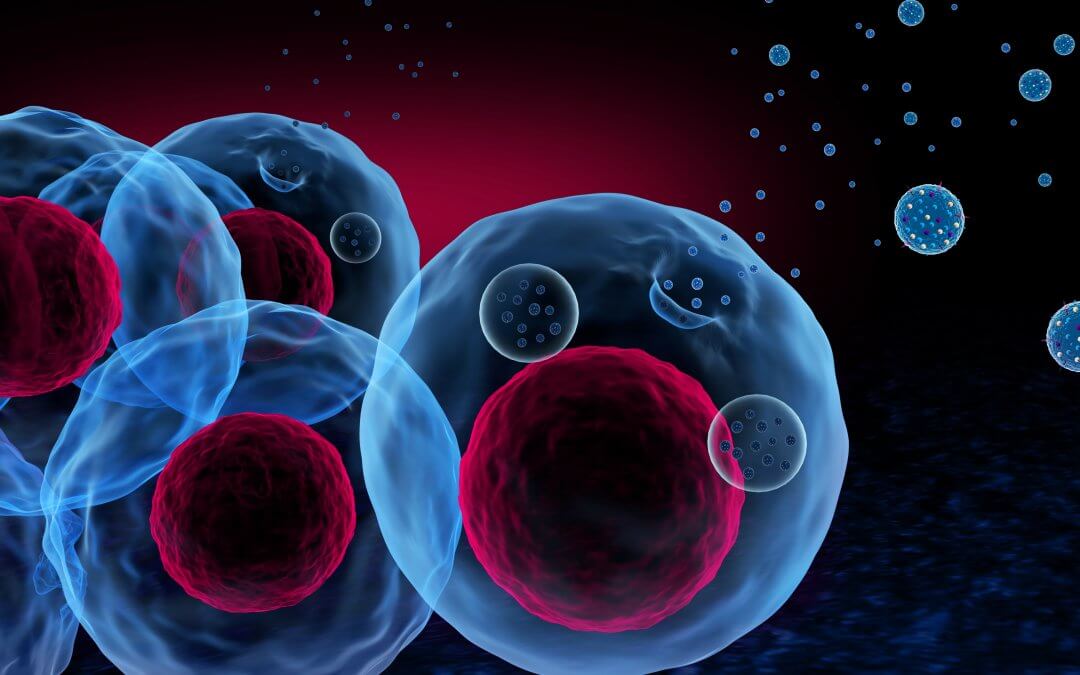
Exosomes are tiny packages released naturally by cells. They carry signals – proteins and genetic messages – from one cell to another, helping to coordinate healing, prompt new tissue and blood vessels to form, and reduce inflammation. [1][3] Because they are produced by stem cells rather than being the cells themselves, exosome therapy is often described as a cell-free approach: the helpful signals are collected and delivered without transplanting whole cells. [3]
Why umbilical cord and amniotic tissue?
The exosomes used in Kaitlin’s treatment came from mesenchymal stem cells (MSCs) taken from umbilical cord and amniotic tissue. [1] MSCs are the broad family of repair cells found in several tissues, including bone marrow, fat, and birth tissues. Umbilical cord tissue – in particular the gel-like Wharton’s jelly – is one of the richest and most studied sources of them. [4] Cord-derived MSCs are young, plentiful, and straightforward to collect after birth, which is part of why researchers are so interested in both the cells and the particles they release. [4]
What does the research show?
Laboratory and animal studies have shown for some years that cord-derived MSC exosomes can speed wound healing, encourage new blood vessels, improve collagen and elastin, and calm harmful inflammation. [5][6][7][8] Other early human reports are now emerging too: a 2026 case report described a deep scald burn treated with cord-derived MSC exosomes that closed within 18 days, with minimal scarring and no adverse effects. [9] The Hamilton team has submitted its own findings as a case report for publication. [1]
These are encouraging signs, but the stage of the science matters. The Hamilton treatment is a single, compassionate-use case rather than a controlled trial, and the exosomes were specially sourced for one patient. [1] Larger, controlled studies are needed to confirm how safe and effective the approach is, and for whom. [9]
What this means for families who store cord blood and tissue
Stories like this one help explain why birth tissues are attracting so much attention in regenerative medicine. The cells from which the exosomes at the centre of this treatment were sourced are mesenchymal stem cells, and umbilical cord tissue is one of the richest sources of them – the same cord tissue that families can choose to store at birth. [4] Storing a baby’s cord blood and cord tissue does not guarantee that the cells or their exosomes will be suitable or needed for any particular treatment, but it keeps the option open and ensures a personal, matched sample is available should it ever be required and clinically appropriate. Cord blood, cord tissue, and placenta can only be collected once – in the moments after birth.
To learn more about umbilical cord stem cells and how you can preserve them, fill in the form below to request your free welcome pack.
References
[1] Diebel, L. (2026) HHS performs world-first burn treatment with incredible results. Hamilton Health Sciences. https://www.hamiltonhealthsciences.ca/share/world-first-burn-treatment/
[2] Chelsea and Westminster Hospital NHS Foundation Trust (2024) Skin grafts (autograft). https://www.chelwest.nhs.uk/your-visit/patient-leaflets/burns/skin-grafts-autograft
[3] Dehghani L, Owliaee I, Sadeghian F, Shojaeian A. The Therapeutic Potential of Human Umbilical Cord Mesenchymal Stromal Cells Derived Exosomes for Wound Healing: Harnessing Exosomes as a Cell-free Therapy. J Stem Cells Regen Med. 2024 May 31;20(1):14-23. doi: 10.46582/jsrm.2003003. PMID: 39044811; PMCID: PMC11262847. https://pmc.ncbi.nlm.nih.gov/articles/PMC11262847/
[4] Davies, J.E., Walker, J.T. and Keating, A. (2017) Concise review – Wharton’s jelly: the rich, but enigmatic, source of mesenchymal stromal cells. Stem Cells Translational Medicine, 6(7), 1620–1630. https://stemcellsjournals.onlinelibrary.wiley.com/doi/10.1002/sctm.16-0492
[5] Yang Y, Huang Y, Yang J, Hu Z, Wu S, Yuan Q, Meng S, Li D, Jiang M, Liao Y, Cai C. Umbilical cord mesenchymal stem cell-derived exosomes promote wound healing and skin regeneration via the regulation of inflammation and angiogenesis. Front Bioeng Biotechnol. 2025 Nov 3;13:1641709. doi: 10.3389/fbioe.2025.1641709. PMID: 41255881; PMCID: PMC12620388. https://www.ncbi.nlm.nih.gov/pmc/articles/PMC12620388/
[6] Zi Y, Li J, Qian X, Li J, Jin Y, Zhang Z, Jin Y. Human umbilical cord mesenchymal stem cell exosomes promote elastin production and acute skin wound healing via TGFβ1-Smad pathway. Mol Cell Biochem. 2025 Jul;480(7):4499-4511. doi: 10.1007/s11010-025-05264-5. Epub 2025 Apr 9. PMID: 40202710; PMCID: PMC12263733. https://pubmed.ncbi.nlm.nih.gov/40202710/
[7] Teng L, Maqsood M, Zhu M, Zhou Y, Kang M, Zhou J, Chen J. Exosomes Derived from Human Umbilical Cord Mesenchymal Stem Cells Accelerate Diabetic Wound Healing via Promoting M2 Macrophage Polarization, Angiogenesis, and Collagen Deposition. Int J Mol Sci. 2022 Sep 9;23(18):10421. doi: 10.3390/ijms231810421. PMID: 36142334; PMCID: PMC9498995. https://www.ncbi.nlm.nih.gov/pmc/articles/PMC9498995/
[8] Zhu Z, Zhang X, Hao H, Xu H, Shu J, Hou Q, Wang M. Exosomes Derived From Umbilical Cord Mesenchymal Stem Cells Treat Cutaneous Nerve Damage and Promote Wound Healing. Front Cell Neurosci. 2022 Jun 30;16:913009. doi: 10.3389/fncel.2022.913009. PMID: 35846563; PMCID: PMC9279568. https://www.ncbi.nlm.nih.gov/pmc/articles/PMC9279568/
[9] Hung C, Chung T, Lin W (April 16, 2026) Topical Application of Human Umbilical Cord-Derived Mesenchymal Stem Cell Exosomes for a Deep Second-Degree Scald Burn Wound: A Case Report. Cureus 18(4): e107198. doi:10.7759/cureus.107198 https://www.cureus.com/articles/455510-topical-application-of-human-umbilical-cord-derived-mesenchymal-stem-cell-exosomes-for-a-deep-second-degree-scald-burn-wound-a-case-report

FIND OUT MORE, REQUEST YOUR WELCOME PACK TODAY
Everything you need to decide about cord blood banking – and, while you decide, Antenatal by Cells4Life: 18 online classes with Cass McNamara, BBC Scotland’s Ask the Midwife, on birth, feeding, newborn care and recovery. It’s free when you request your welcome pack.
Provide your contact details to request:
- Complete Welcome Pack and Parent’s Guide
- Your discount
- save up to £500
on cord blood banking
- Information via email
- Free access to our full 18-class online antenatal course, including a video class on cord blood banking
- A call from one of our specialist advisers