
Key details
The condition: Pre-eclampsia affects around one in 20 pregnancies worldwide and, together with foetal growth restriction, is a major cause of stillbirth and of illness in mothers and newborns [1, 2].
The discovery: Cambridge scientists found that low levels of a placental protein called isthmin-2 in the mother’s blood at around 12 weeks were the strongest early signal, out of 2,904 proteins measured, that a pregnancy would go on to develop pre-eclampsia or foetal growth restriction [1, 2].
The stem cell science: Switching the protein off in human trophoblast stem cells and in “mini-placentas” grown in the laboratory stopped the cells from invading the surrounding tissue, suggesting isthmin-2 may help drive these conditions rather than simply mark them [1, 2].
What comes next: The team hopes the finding will lead to new early tests, and potentially new treatments, for the pregnancies at greatest risk [2, 3].
Pre-eclampsia is one of the conditions midwives check for at every routine antenatal appointment [4]. On 1 September 2026, researchers at the University of Cambridge published a study in Nature Medicine identifying a protein in the mother’s blood that, measured at around 12 weeks, gave the strongest early warning signal of pre-eclampsia and a related condition, foetal growth restriction, among the thousands of proteins they tested [1, 2]. The laboratory work behind it relied on placental stem cells, and it offers a remarkable view of how the placenta builds a baby’s lifeline.
What Is Pre-Eclampsia?
Pre-eclampsia is a pregnancy-related condition that causes high blood pressure [4]. Its early signs – raised blood pressure and protein in the urine – are rarely noticeable, which is why blood pressure and urine are checked at routine antenatal appointments [4]. It is most likely from 20 weeks of pregnancy onwards, although it can occur at any point, and occasionally in the days or weeks after birth [4].
In most cases pre-eclampsia is not severe, but it can slow a baby’s growth or lead to an early birth, and in some cases it causes more serious complications [4]. There is currently no cure, although treatments help manage it and symptoms usually improve once the baby is born [4]. The UK charity Action on Pre-eclampsia describes it as the most common of the serious complications of pregnancy, and one caused by a defect in the placenta [5].
Foetal growth restriction, where a baby does not reach its growth potential in the womb, is closely related. It affects roughly 3 to 10 per cent of pregnancies in high-income countries and up to one in five pregnancies worldwide [2].
Why Does The Placenta Matter So Much?
The placenta connects mother and baby, supplying oxygen and nutrients throughout pregnancy [5]. To do that, specialised placental cells called extravillous trophoblasts burrow into the wall of the womb early in pregnancy and establish a healthy blood supply [2]. Both pre-eclampsia and foetal growth restriction are linked to this invasion falling short [1, 2].
Humans have the deepest placental invasion of any mammal [1]. Professor Gordon Smith, who led the study, links this to the enormous demands of building what he calls “the most complex machine ever known, the human brain” [2]. Until now, the reason the invasion sometimes fails had been unclear [2].
What Did The Cambridge Team Find?
The researchers analysed blood samples taken at around 12 weeks of pregnancy from women in the Pregnancy Outcome Prediction Study, which ran at the Rosie Hospital, part of Cambridge University Hospitals NHS Foundation Trust, from 2008 to 2012 [2, 3]. They compared more than 200 women whose pregnancies went on to be affected by pre-eclampsia or foetal growth restriction with more than 200 women whose pregnancies were unaffected [2].
- One protein stood out. Of 2,904 proteins measured, low levels of isthmin-2 were the strongest early signal for the complications, and the only protein linked to all four outcomes the team studied [1].
- It performed well against existing markers. Isthmin-2 predicted the complications significantly better than five established placental markers measured in the same samples [1].
- The result held up in other groups. The finding was confirmed in a second pregnancy cohort from the same research programme and in a Swedish study that included more than 100 affected and 200 unaffected pregnancies [1, 3].
- It comes from the placenta. Isthmin-2 is made almost exclusively in the placenta, and within it mainly by the invasive extravillous trophoblast cells [1, 2].
How Did Stem Cells Help Explain The Finding?
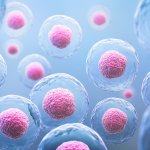
A link in a blood test does not by itself show cause. To test whether isthmin-2 actually matters, the team turned to two laboratory tools developed in the past decade: human trophoblast stem cells, first derived in 2018, which can develop into the cell types of the placenta [1, 6], and placental organoids, three-dimensional “mini-placentas” developed the same year [1, 7].
- Without isthmin-2, stem cells could not become invasive. When the protein was switched off in trophoblast stem cells, the cells survived and grew normally but failed to turn into the invasive cells that burrow into the womb [1, 2].
- Mini-placentas stopped spreading. In placental organoids lacking the protein, cells no longer moved into the surrounding material, which mimicked the womb [2].
- Adding the protein had the opposite effect. Kidney cells that do not normally make isthmin-2 became more invasive when made to produce it [1, 2].
Together, these results suggest isthmin-2 may be causally involved in the early placental problems behind both conditions [1].
What Could This Mean For Pregnancy Care?
Professor Smith says early-pregnancy isthmin-2 levels are much better at predicting complications than existing tests, which could help identify the pregnancies at greatest risk [2, 3]. At present, women judged to be at higher risk of pre-eclampsia may be offered daily aspirin from week 12 of pregnancy [4], so a clearer signal at around the same point in pregnancy is a promising prospect.
The team also sees potential for treatment: finding a way to boost isthmin-2 in the placenta might help prevent these conditions, while blocking it could one day help where a placenta has implanted in the wrong place, such as in ectopic or caesarean scar pregnancies [2, 3]. The team hopes the discovery will now lead to new predictive tests [3]. If you have any questions about pre-eclampsia in your own pregnancy, talk to your midwife [4, 5].
What Does This Mean For Families Thinking About Cord Blood And Cord Tissue?
This study is a reminder of how much the placenta and umbilical cord do during pregnancy, and how much scientists are still learning from the stem cells of the placenta. The umbilical cord is valuable after birth too: cord tissue is a rich, young source of mesenchymal stem cells, which are being studied widely in regenerative medicine [8].
Cord blood and cord tissue can only be collected at birth, and storing them preserves a young, matched sample for your baby should it be required in the future. To learn more about umbilical cord stem cells and how you can preserve them, fill in the form below to request your free welcome pack.
References
- Miao, R., Gong, S., Sovio, U., Aye, I. L. M. H., et al. (2026). Isthmin-2 is a first-trimester predictor of preeclampsia and fetal growth restriction. Nature Medicine, 32(9), 3351–3358. https://doi.org/10.1038/s41591-026-04573-6
- University of Cambridge (2026). Pre-eclampsia discovery could lead to new test and treatments for at-risk pregnancies. https://www.cam.ac.uk/research/news/pre-eclampsia-discovery-could-lead-to-new-test-and-treatments-for-at-risk-pregnancies
- Cambridge University Hospitals NHS Foundation Trust (2026). Pregnancy study finds ‘red flag’ that could lead to test for pre-eclampsia. https://www.cuh.nhs.uk/news/pregnancy-study-red-flag-could-lead-test-pre-eclampsia/
- NHS (2026). Pre-eclampsia. https://www.nhs.uk/conditions/pre-eclampsia/
- Action on Pre-eclampsia (2024). What is pre-eclampsia? https://action-on-pre-eclampsia.org.uk/what-is-pre-eclampsia/
- Okae, H., Toh, H., Sato, T., et al. (2018). Derivation of human trophoblast stem cells. Cell Stem Cell, 22(1), 50–63.e6. https://doi.org/10.1016/j.stem.2017.11.004
- Turco, M. Y., Gardner, L., Kay, R. G., et al. (2018). Trophoblast organoids as a model for maternal–fetal interactions during human placentation. Nature, 564(7735), 263–267. https://doi.org/10.1038/s41586-018-0753-3
- Nagamura-Inoue, T., & He, H. (2014). Umbilical cord-derived mesenchymal stem cells: Their advantages and potential clinical utility. World Journal of Stem Cells, 6(2), 195–202. https://doi.org/10.4252/wjsc.v6.i2.195

FIND OUT MORE, REQUEST YOUR WELCOME PACK TODAY
Everything you need to decide about cord blood banking – and, while you decide, Antenatal by Cells4Life: 18 online classes with Cass McNamara, BBC Scotland’s Ask the Midwife, on birth, feeding, newborn care and recovery. It’s free when you request your welcome pack.
Provide your contact details to request:
- Complete Welcome Pack and Parent’s Guide
- Your discount
- save up to £500
on cord blood banking
- Information via email
- Free access to our full 18-class online antenatal course, including a video class on cord blood banking
- A call from one of our specialist advisers